Hey friend. If you’re in the first month of school, you’re probably saying some version of these sentences all day long:
“Take out your notebook.”
“Read the directions.”
“Where are you supposed to turn that in?”
“No, the other page.”
“Please stop tapping your pencil.”
And then, somehow, the bell rings and you do it all again with a completely different group of children. SIGH.
The good news is that you don’t need another complicated classroom management strategy. You need a few predictable, low-prep routines that your students can follow without waiting for you to narrate every single move.
These are five middle school math classroom routines that work because they’re simple, repeatable, and easy to teach. You can start using them tomorrow.
A routine is more than a list of procedures on the wall. It’s a system students practice until they know what to do next.
When your routines are predictable, your students spend less time asking, “What are we doing?” and more time actually doing math. You also get more time to circulate, check understanding, and help the student who is staring at a fraction like it personally offended them.
But here’s where I used to mess up , I thought posting directions meant I had taught the routine.
It did not.
Students need to see the routine, hear the routine, practice the routine, and occasionally practice it again after a long weekend. Learn from my mistakes. Do not assume that because a direction is on the board, it has magically entered every student’s brain.
The first five minutes of class can either set the tone for learning or turn into a tiny daily emergency.
You know the scene. Students are wandering in, asking for pencils, checking their phones, stopping to tell you about lunch, and somehow nobody knows what to do even though the bell rang three minutes ago.
A consistent entry routine might look like this:
That’s it. Same order. Same location. Every day.

I like using Daily Agenda Slides because students always know where to look. I can include the learning target, the warm-up, an attendance question, and any materials they need for the lesson.
Post the directions in the same place and use the same wording. Then, when a student asks, “What are we doing?” you can point to the board and say, “Start with step one.”
Not rude. Not dramatic. Just a system.
Model the routine as if you are a student. Walk in, pick up the paper, sit down, and start the warm-up.
Then have students practice it.
Yes, practice walking into class. I know it feels a little ridiculous. But spending ten minutes practicing now can save you ten minutes every day for the rest of the year.
Your warm-up should be a familiar structure with changing math.
That distinction matters.
Students should know how to begin even when the skill changes. Maybe they solve two spiral review questions, respond to a quick attendance question, or explain their thinking about a problem on the board.
Keep the format consistent:
A simple warm-up routine could be:
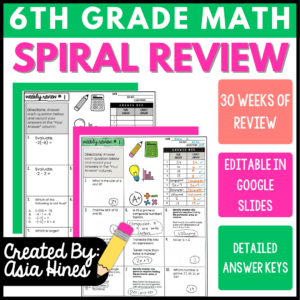
I love using spiral review for this because it keeps previously taught skills fresh without creating another homework pile. You can give students two or three questions each day and use Friday for a short check-in.
The magic is not in finding a brand-new warm-up activity every day. The magic is in students knowing exactly how to start.
You can grab the free Warm Up Template if you want a quick way to create a consistent beginning-of-class routine.
Choose one warm-up format and use it for an entire week before changing anything.
Do not switch from a worksheet to a number talk to a digital game to a partner puzzle every morning because you’re worried students will get bored. Your students can handle repetition. Your teacher brain needs the break.
Middle school students lose things with impressive dedication.
Their pencil disappears while they’re holding it. Their worksheet vanishes between the door and their desk. Their notebook is “at home,” even though they used it yesterday and have not left the building.
You cannot personally become the lost-and-found department for every class period.
Instead, create clear homes for common materials:
A math binder or folder system can make this much easier. In my own classroom, I used sections for warm-ups and spiral review, current Guided Notes, permanent Guided Notes, and student data.
The exact system can look different in your room. The important part is that students know:
And please don’t create 14 complicated locations that require a tour guide and a color-coded map. Start with three or four systems your students will actually use.
You can read more about how I organize students with a math binder system and borrow whatever makes sense for your classroom.
Hold up each item and ask, “Where does this go?”
Then let students practice putting it away.
After that, make them retrieve it. Because of course, knowing where something goes and remembering where something goes are two completely different skills.
One of the fastest ways to lose your entire planning period is to answer the same question 28 times while students are working.
“What page are we on?”
“What does this word mean?”
“Do I have to show my work?”
“Is this right?”
Some questions are important. But many of them are questions students could answer by checking the directions, their notes, or a classmate.
That’s why I recommend teaching a help routine with clear steps:
You can adjust the order for your classroom, but make the process visible. Post it near the board or include it on your daily slides.
Guided Notes are especially helpful here because students have a consistent reference instead of relying on a half-finished notebook page from three weeks ago. Clear examples, vocabulary, and step-by-step procedures give students something to check before they call you over.
You can read why Guided Notes help middle school math students for ideas on building this kind of support into your lessons.
Role-play a student who is stuck.
Ask the class, “What should I do first?”
Then model the wrong way too , staring at the paper, calling your name across the room, and announcing, “I don’t get it!” Middle schoolers will recognize this immediately because, well, they’ve seen it before.
Practice the help routine until it feels normal.
The last three minutes of class should not feel like a fire drill.
If students are packing up before you’ve finished speaking, shoving papers into random folders, and lining up at the door like they’re escaping a haunted house, your closing routine needs some structure.
Try this sequence:
Your exit ticket does not need to be a full assessment. One carefully chosen problem can tell you plenty.
You might ask students to:
The key is doing it consistently and using the information. If every student misses the same step, that’s tomorrow’s warm-up. If three students are still confused, pull them for a quick small group while the rest of the class gets started.
Give students a two-minute warning before the closing routine begins.
Then use the same words every day : “Finish the problem, turn it in, check your area, and wait for dismissal.”
It may sound repetitive to you. That’s okay. Repetition is the whole point. Eventually, students will begin the routine before you finish saying it.
You do not need to launch all five routines perfectly on the same day. That sounds exhausting, and you already have enough going on.
Start with these three:
Then add the materials system and help routine once students understand the basic flow.
For every routine, use this process:
And when students forget? Redirect them to the routine instead of giving a brand-new speech.
“You’re on step two.”
“Check the agenda.”
“Use the help routine.”
“Where does that paper go?”
Short. Calm. Consistent.
You don’t need to say more. You need to say the same useful thing until the system starts doing some of the work for you.
If you want a smooth start, try this:
That’s enough to begin.
The best middle school math classroom routines that work are not the fanciest ones. They’re the ones you can repeat on a Monday morning, a rainy Thursday, and the day after a three-day weekend when everyone : including you : has temporarily forgotten how school works.
Start with one routine. Practice it like a boss. Then add the next.
Which routine are you starting tomorrow : the entry routine, the warm-up, or the end-of-class reset? Pick one and try it for a full week.

I’m Asia! I’m all about making middle school math less work for you and more fun for your students. I’ve got tons of ready-to-go activities for grades 6–8 that keep kids engaged while you keep your sanity.
Welcome to my Blog!
I started The Sassy Math Teacher to help teachers like you increase classroom engagement and teach middle school math with confidence!
I also love to share about my life as a teacher including my favorite outfits, home items, gadgets and trips!