

Can we talk about the week before Thanksgiving break for a second?
Half your class is already mentally at Grandma’s house. The other half wants to know if we’re “doing anything fun today.” And you still have standards to teach, because the pacing guide does not care that there’s pie on the way.
I’ll never forget my first year teaching when I assumed business could go as planned. For starters, half the kids are absent, and their little brains are just checked out. So business as usual just doesn’t work.
I used to think I had two options that week: push through a normal lesson and fight for every minute, or hand out a word search and call it a day. SIGH. Neither one felt right.
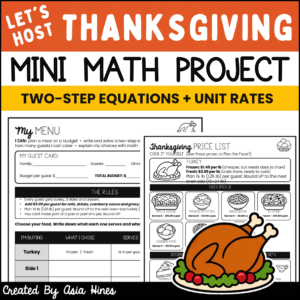
So this year I made a third option. A Thanksgiving math project that feels like a break to students but is secretly full of 7th grade math. It’s called Let’s Host Thanksgiving! and it fits in one class period.
Here’s exactly how it works, how I’d run it, and what to watch for.

A worksheet asks students to find an answer. A project asks them to make a decision.
In this one, every pair is planning a real Thanksgiving dinner for a real-ish family. They have a guest count, a budget and a dinner time, and they have to make it all work. Do they buy the cheaper frozen turkey and remember to thaw it? Do they splurge on mac and cheese and skip the green beans? Do they just call a caterer?
There’s more than one right answer. That’s the whole point. Students have to adjust their plan, check their math and explain their thinking, and that’s where the good conversations happen.
And they’re practicing a LOT of math along the way:
There are 12 Guest Cards, and each one is a different family. The card tells students their family name, how many guests are coming, their total budget and what time dinner is. Pull them out of a basket or a bowl and let pairs pick one. The kids love the suspense of who they got.
Students use the Thanksgiving Price List to choose their food on the My Menu page. The rules are simple: every guest gets turkey, 3 sides and a dessert. Each pan or pie serves a certain number of people, so students have to figure out how many they need.
The turkey is where the unit rate thinking kicks in. Students plan 1¼ pounds of turkey per guest, and then they choose:
Tell them to look at that price difference closely. A 20 pound turkey is almost $30 cheaper frozen, and that money might be the difference between staying on budget and not!

On Plan the Feast!, students do the math for every item: guests ÷ servings, round up, then multiply by the price. They add $3.00 per guest for rolls, drinks, cranberry sauce and gravy, find their total, and check it against their budget.
Here’s what I love. A lot of groups go over budget on the first try. (Because who doesn’t want two kinds of pie?!) So they have to go back, swap something out and find their new total. That revision is the most valuable math they’ll do all day.
Make sure you emphasize the rounding. If students need 2.67 pans, they buy 3. You can’t make part of a pan, and you definitely can’t serve part of a pie.
Next, students meet Gobble Good Catering. They bring all 3 sides and dessert for $14.50 per guest plus a $40 delivery fee.
Students figure out how much money they have left after buying the turkey and extras, then write and solve a two-step equation to find how many guests the caterer could feed with that money.
Then they decide. Is catering worth it for their family, or should they cook? They have to explain why with math, not just “because cooking is hard.” LOL.
The last problem is my favorite. The turkey cooks for 15 minutes per pound and then rests for 30 minutes before dinner. Students take their turkey size and their dinner time and work backward to find when the turkey needs to go in the oven.
Working backward with elapsed time trips up a lot of 7th graders, so this is a great quick check. Have them write the total minutes first, convert to hours and minutes, and then count back from dinner.

If you want students out of their seats (and the week before break, you probably do), hang the 12 grocery store station posters around the room. Each poster shows one item from the Price List, like the turkey, mac and cheese or pumpkin pie, with its price and how many people it serves.
Instead of reading the Price List at their desks, pairs “shop” the room and write down what they need. It instantly feels like a field trip to the grocery store.
When everyone is finished, do a quick gallery walk. Pairs post their plans and everyone looks for who stayed the furthest under budget, who catered, and who has to put their turkey in the oven at 4 a.m. (There’s always one.)
My students always love an opportunity to give an opinion, so this is a nice addition.
This project is built to fit in one class period. Here’s the timing I’d use:
Need more time? Stop after Plan the Feast! and finish Cook or Cater? the next day. It works great spread across two days too.

It’s aligned to CCSS 7.EE.B.4a, 7.RP.A.2 and 7.EE.B.3, plus VA SOL and TEKS, so you can feel good about using it during that week.
If you’re ready to give your students a Thanksgiving math project they’ll actually want to do, grab Let’s Host Thanksgiving! here.
It’s written for 7th grade and works well for 8th grade review. The math lines up with 7th grade unit rates and two-step equations.
About 60 minutes, or one class period. You can also split it across two days by stopping after Plan the Feast!
Unit rates, operations with decimals and money, rounding up, budgeting, two-step equations and elapsed time.
Yes! Every family has a different budget, and students choose their own menu, so answers will vary. The answer key includes one sample plan and tips for checking open-ended work.
Nope. The stations and gallery walk are optional. Students can use the Price List at their desks instead.
The week before Thanksgiving doesn’t have to be a choice between a fight and a word search. Give students a budget, a family to feed and a turkey that has to go in the oven on time, and watch how much math they’re willing to do.
Are you a Math That Clicks Club member? Don’t buy this one! It’s already waiting for you in The File Cabinet. Not a member yet? Join the Math That Clicks Club to get this project plus ready-to-teach 7th grade lessons.
Will you try it this year? I’d love to hear who your students decide to cater!

I’m Asia! I’m all about making middle school math less work for you and more fun for your students. I’ve got tons of ready-to-go activities for grades 6–8 that keep kids engaged while you keep your sanity.
Welcome to my Blog!
I started The Sassy Math Teacher to help teachers like you increase classroom engagement and teach middle school math with confidence!
I also love to share about my life as a teacher including my favorite outfits, home items, gadgets and trips!