

Have you ever noticed a dirt path worn into the grass, right where everyone cuts the corner instead of staying on the sidewalk? There’s actually a name for that: a desire path.

That’s how I open my Pythagorean theorem lessons. I show my students a desire path and ask them: Why did people make this? Is cutting across the grass actually faster than walking all the way around on the sidewalk? And how much faster?
Kids LOVE picking a side on this one. And they have NO idea they’re about to do 8th grade math to prove the shortcut-takers right.
Here’s how I plan my Pythagorean theorem lessons over four days, plus the one review I always do first so the arithmetic doesn’t get in the way.
Please don’t skip this. If students don’t know their perfect squares, the Pythagorean theorem turns into a calculator scavenger hunt, and the actual idea gets lost.
Before we start, I review:
This is a GREAT spot for a quick Blooket or Kahoot. I keep it fast and fun. If your class needs more time here, take it. It pays off on Day 2.
I never start with the formula. If you hand kids a² + b² = c² on Day 1, they memorize letters and plug in numbers wherever they want. SIGH.
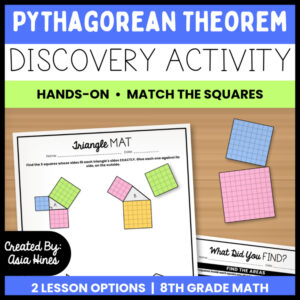
Instead, we prove it with squares. Students match squares to the sides of a few different triangles, find the area of each square, and look for a pattern. Some of the triangles are right triangles and some aren’t, and that’s the whole point.
Then I ask, “What do you notice?”
Someone always spots it: the two smaller squares add up to the big one, but only on the right triangles. That’s when I tell them this is called the Pythagorean theorem, and they just discovered it themselves.
Then we connect the proof to the vocabulary. The two sides that make the right angle are the legs. The longest side, across from the right angle, is the hypotenuse. I have them trace the hypotenuse in a different color on every triangle for the rest of the unit. It sounds small, but it saves SO many mistakes later.
I use my Pythagorean Theorem Discovery Activity for this, so the squares and triangles are ready to go.

Now that they know why it works, we take notes. I use these Pythagorean theorem guided notes so students aren’t copying the board while trying to understand something new. The learning target is right at the top of each page, and there’s practice built in for finding the hypotenuse and the legs.

The steps I have students write every time:
Step 5 is where kids stop early. They get c² = 100 and write “100” as their answer. I make them ask themselves, “Does my answer make sense? Is the hypotenuse the longest side?” If their hypotenuse is way longer than both legs put together, something went wrong.
Finding a missing leg is where the real mistakes happen. Students see two numbers, add their squares, and call it a day. Even when one of those numbers is the hypotenuse. SIGGGH.
This is why the colored hypotenuse matters. Before they do anything, I have them ask: “Do I already know the hypotenuse?”
Once they’ve got that, we move to word problems, and this is where my opening question comes back. Ladders against a wall, TV screen sizes, ramps and, of course, our desire path. (How much shorter is the shortcut?) I have students draw the triangle first, every time, and label the hypotenuse before they touch the numbers.
For practice, I love this Pythagorean theorem word problems activity. It’s self-checking: students find their answer in the answer bank, and the answers spell out a word. If their answer isn’t in the bank, they know right away to go back and check. It works for stations, partner work or homework, and it comes digital and printable.
Before students practice on their own, I work through three examples with them, one of each type they’ll see. I keep the same routine every time: draw it, label the sides, and mark the hypotenuse (the side opposite the right angle) first.
A right triangle has legs of 5 and 12. What is the length of the hypotenuse?
5² + 12² = c², so 25 + 144 = 169. The sum of the squares is 169, so c = √169 = 13.
A right triangle has a hypotenuse of 17 and one leg of 8. Find the missing side.
We already know the hypotenuse, so we subtract: 17² − 8² = 289 − 64 = 225. The missing leg is √225 = 15.
The sidewalk goes 30 feet along one side of a grassy corner and 40 feet along the other. How much shorter is the shortcut across the grass?
30² + 40² = 900 + 1,600 = 2,500, and √2,500 = 50. Walking the sidewalk is 70 feet, so the desire path saves 20 feet. This is the moment the shortcut-takers in the room feel VERY proud of themselves.
The converse flips the question. Instead of finding a side, students get three side lengths and decide whether the triangle is a right triangle.
The mistake to watch for: students plug the numbers in the order they’re given. If the problem says 10, 6, 8, they’ll make 10 a leg. Have them circle the longest side first, every time.
The converse is also in the guided notes, so Day 4 picks up right where Day 3 left off.
Most students learn it in 8th grade. It’s in the Common Core 8th grade standards (8.G.B.6–8), the Virginia 8th grade SOL (8.MG.4) and the Texas 8th grade TEKS. Some advanced 7th grade classes see it too.
Adding the squares when they should subtract. When students already know the hypotenuse, they need c² − a² to find the missing leg. Having them mark the hypotenuse first fixes most of it.
Let students discover it with the visual proof before you give them the formula. Then keep it in your spiral review after the unit so it doesn’t disappear by state testing.
It says that if the squares of the two shorter sides add up to the square of the longest side, the triangle is a right triangle. Students use it to check whether three side lengths make a right triangle.
Pythagorean triples are sets of three whole numbers that work in a² + b² = c², like 3-4-5, 5-12-13, 8-15-17 and 7-24-25. Any multiple works too, so 6-8-10 is a triple because it’s just 3-4-5 doubled. They’re worth knowing because they show up all over word problems and tests, and spotting one saves a lot of calculating.
Start with a desire path, let them prove it with squares, and save the formula for Day 2. Your students will remember WHY it works, not just a² + b² = c².
If you want 8th grade lessons like this planned for you (the hook, the notes, the practice and the exit tickets), the 8th grade Math That Clicks Club is opening soon. Join the waitlist here so you’re the first to know.
Will you try the visual proof this year? Let me know how it goes!
Pin it so it’s ready when your Pythagorean theorem unit comes around!


I’m Asia! I’m all about making middle school math less work for you and more fun for your students. I’ve got tons of ready-to-go activities for grades 6–8 that keep kids engaged while you keep your sanity.
Welcome to my Blog!
I started The Sassy Math Teacher to help teachers like you increase classroom engagement and teach middle school math with confidence!
I also love to share about my life as a teacher including my favorite outfits, home items, gadgets and trips!